

Dermatologist-Supervised Laser Hair Reduction in Kathmandu
If you are tired of painful monthly waxing, threading cuts, ingrown bumps, and dark razor shadows, clinical laser hair reduction offers a lasting solution. At Derma Clinic Kathmandu, every treatment course starts with a skin and hair assessment by board-certified dermatologist Dr. Utsav Sharma. Laser parameters are calibrated by the doctor and delivered under medical supervision by our clinical nursing team using a multi-wavelength diode platform.
The Science of Smooth Skin: How Laser Hair Reduction Works
Shaving only trims hair above the skin, and waxing rips the hair shaft out while leaving the root’s blood supply intact. Clinical laser hair reduction works on a principle called selective photothermolysis—using a precise beam of light to disable the hair-producing factory beneath the skin without harming the surrounding tissue[3].
From Light Absorption to Follicle Inactivation
During your session, the laser handpiece glides over your skin and emits a concentrated pulse of light. Laser energy penetrates the skin and is preferentially absorbed by pigment (melanin) within the hair shaft and follicle.
In a fraction of a second, the absorbed light converts into controlled thermal energy. That heat travels down to the follicular bulb and stem-cell bulge, heating the protein structures and disabling the follicle’s ability to grow a thick dark hair in future cycles.
Why Dermatologists Say “Hair Reduction” Instead of “100% Removal”
We use the medically accurate term permanent hair reduction rather than promising “100% permanent removal.” As the U.S. FDA and American Academy of Dermatology (AAD) emphasize, no laser can guarantee the lifelong eradication of every single hair[1][2]. A full course can substantially reduce the number of active coarse hairs, though individual responses vary, and any hair that eventually regrows is typically finer, lighter, and sparser. Because hormones, pregnancy, or PCOS can awaken dormant follicles later in life, an occasional touch-up keeps your skin smooth[1].

How Our Simultaneous Triple-Wavelength Laser Works on Nepali Skin
If you look closely at areas like the female face, forearms, or legs, you will notice that not all hairs are the same: some are fine and shallow, while others are thick and rooted deep in the dermis. Older single-wavelength lasers only target one depth at a time.
At Derma Clinic Kathmandu, the clinical platform we utilize features a multi-wavelength diode handpiece (with a manufacturer-rated 3000W optical power module) engineered to emit nominal 755nm, 808nm, and 1064nm bands simultaneously in every pulse:
For Fine & Shallow Hair
The 755nm band absorbs strongly in melanin to target shallower hair bulbs and finer pigmented hairs on areas like the upper lip, cheeks, forehead, and forearms[3].
For Medium-Depth Body Hair
The classic 808nm diode band penetrates to mid-dermal depth for fast, even heating across large body areas including full arms, full legs, abdomen, chest, and back[3].
For Deep & Coarse Roots
The 1064nm band reaches the deepest level of the dermis to target coarse, stubborn roots in the underarms, bikini line, and natal cleft (pilonidal sinus).
How We Protect Nepali Skin Tones When Wavelengths Fire Together
Because these wavelengths fire together in a single blended pulse, we do not switch individual wavelengths on or off. Because epidermal melanin can also absorb energy, no laser machine is automatically risk-free on its own—improper settings on any laser can cause burns or pigment changes on darker skin tones[1].
To help reduce the risk of thermal injury on Nepali skin tones (Fitzpatrick Types III to V), Dr. Utsav Sharma calibrates three crucial machine controls before your session:
By lengthening the pulse duration (measured in milliseconds) for deeper Nepali skin tones, the tiny pigment granules in your surface skin cool down safely between pulses while the thicker hair root holds onto the heat[3].
Energy density (fluence in J/cm²) and pulse repetition rate (Hz) are matched to your hair thickness after a skin evaluation, building follicular heat smoothly without overheating the epidermis.
A refrigerated sapphire crystal window stays pressed against your gel-coated skin before, during, and after every pulse, numbing the surface and helping reduce the risk of thermal injury.
Explore Typical Session Ranges & Scheduling Intervals
Choose your target body zone, hair texture, and hormonal profile below to see how Dr. Utsav Sharma typically structures a treatment schedule.
*Medical Disclaimer: The figures above are general educational illustrations based on standard dermatological scheduling protocols and do not represent a personalized medical prediction or guaranteed outcome. Exact session counts and suitability are confirmed during your in-clinic examination with Dr. Utsav Sharma.
How Many Sessions Are Required and Why Must They Be Spaced Out?
According to the American Academy of Dermatology, results vary, but patients often notice a reduction in hair after their first treatment, requiring a series of 6 to 8 sessions to achieve substantial long-term hair reduction[1]. We cannot clear all hair in one visit because your hair follicles grow in three staggered biological stages:
1. Anagen (Active Growth Phase)
Depending on the anatomical site, a specific fraction of your hair is in the active Anagen phase at any given time. During Anagen, the dark hair shaft is firmly plugged into the root base—making it the stage where laser heat is most effective at disabling the follicle[3].
2. Catagen (Transition Phase)
For 1 to 2 weeks, the lower follicle shrinks and detaches from its blood supply. Because the hair shaft has unplugged from the base, laser heat cannot travel down efficiently to disable the root’s growth cells.
3. Telogen (Resting Phase)
Dormant follicles rest for several weeks before waking up and entering Anagen again. Spacing visits every 4 to 6 weeks for the face and every 6 to 8 weeks for the body catches each new wave of hair as it becomes active.
What Happens After Your Visit: The 7-to-21 Day Shedding Window
First-time patients are often surprised to see hair still sitting in the pores the day after a laser session. Laser hair reduction does not vaporize hair on the spot; instead, the disabled hair shafts slowly push upward and shed naturally over 7 to 21 days[1]. During this two-week window, it may look like the hair is growing, when in fact the dead shafts are simply sliding out of the skin. Avoid tweezing or waxing them—gentle washing with a soft cloth after day 5 helps them release cleanly.
PCOS Facial Hirsutism & Adjunctive Pilonidal Sinus Care
When Does Facial Hair Warrant Hormonal Testing (PCOS)?
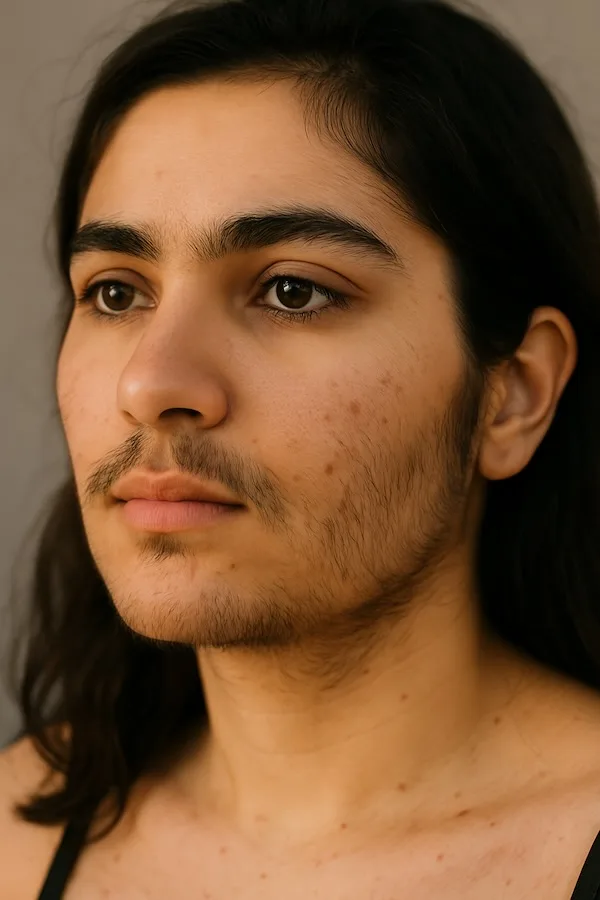
Many women book laser hair reduction for mild, hereditary upper lip or chin hair and do not need laboratory blood tests. However, if you notice thick, coarse hair growth along the chin, jawline, neck, chest, or lower stomach—especially if paired with irregular periods, sudden-onset hair growth, stubborn jawline acne, or scalp hair thinning—higher androgen levels from Polycystic Ovary Syndrome (PCOS) may be a contributing factor[3].
When an underlying hormonal condition contributes to excessive hair growth, appropriate medical management may help reduce new coarse hair growth. Laser hair reduction can address existing pigmented hairs, although additional or maintenance sessions may be needed. When clinically indicated, Dr. Utsav Sharma can arrange targeted hormone testing through our in-house laboratory, Apollo Diagnostic Center.
Laser Hair Reduction for Pilonidal Sinus Disease
In patients prone to pilonidal sinus disease, stiff hairs in the lower back and natal cleft (tailbone crease) can burrow into skin pits or healing surgical scars, triggering painful repeat infections and abscesses. Laser treatment is not a standalone cure for an active, infected pilonidal cyst—which requires surgical or medical care first. Rather, natal cleft laser hair reduction is used as a preventive adjunct after surgical healing (or in mild, non-acute cases alongside your surgeon’s care) to clear coarse hair in the crease and help reduce the risk of recurrence[3].
Clearing Razor Bumps, Folliculitis & Post-Wax Marks
Constant shaving, waxing, or epilating of the underarms, bikini line, and legs often causes sharp regrowing hair tips to curl back into the skin wall—creating painful ingrown bumps (pseudofolliculitis), infected pimples (folliculitis), and dotted dark marks (“strawberry legs”). Disabling the hair root with laser removes the trapped hair shaft so bumps flatten out and dark marks can fade naturally.
Who Performs Your Treatment? Our 4-Step Clinical Workflow
At Derma Clinic Kathmandu, every session combines direct dermatologist parameter calibration with attentive clinical nursing care:
Doctor Assessment
Dr. Utsav Sharma evaluates your skin tone, hair thickness, and medical history, and sets your exact fluence (J/cm²) and pulse-duration parameters.
Prep & Cooling Gel
The skin is cleansed, marked into treatment grids, fitted with wavelength-specific protective eyewear, and coated with chilled ultrasound gel.
Supervised Laser Pass
Our trained clinical nursing team (including Staff Nurse Rakshya Bhandari) performs the sapphire-cooled laser passes under direct dermatologist supervision.
Soothing & SPF Care
Cooling gel is wiped away, calming post-laser cream and broad-spectrum SPF 50 sunscreen are applied, and your next growth-cycle visit is scheduled.
What Is the Cost of Laser Hair Reduction in Kathmandu?
All rates below are per single session in Nepalese Rupees (NPR) and include your dermatologist assessment, skin preparation, cooling ultrasound gel, the laser procedure, and post-procedure soothing cream—with zero hidden consumable fees. Upfront 6-session packages qualify for discounted package rates. For our full 13-zone tariff and interactive multi-area calculator, visit our dedicated laser hair removal prices page.
| Popular Treatment Area | Clinical Coverage | Typical Interval | Price per Session (NPR) |
|---|---|---|---|
| Upper Lips | Upper lip facial zone | Every 4 – 6 Weeks | Rs. 3,000 |
| Upper Lips & Chin | Combined lower face (Commonly booked for PCOS) | Every 4 – 6 Weeks | Rs. 5,000 |
| Bikini Area | Bikini line & intimate hygiene zone | Every 6 – 8 Weeks | Rs. 5,000 |
| Under Arms (Bilateral) | Both underarms (Axillae) | Every 6 – 8 Weeks | Rs. 6,000 |
| Full Face | Upper lip, chin, jawline, cheeks & sideburns | Every 4 – 6 Weeks | Rs. 8,000 |
| Laser for Pilonidal Sinus | Natal cleft / lower back recurrence prevention | Every 6 – 8 Weeks | Rs. 8,000 |
| Full Hands / Arms (Bilateral) | Both arms from shoulders to fingers | Every 6 – 8 Weeks | Rs. 10,000 |
| Full Legs (Bilateral) | Both thighs, knees, and lower legs | Every 6 – 8 Weeks | Rs. 12,000 |
| Whole Body Package | Full arms, underarms, legs, chest, abdomen & back (Excl. face & bikini) | Every 6 – 8 Weeks | Rs. 25,000 |
Preparing for Your Laser Session: Do’s, Don’ts & Aftercare
Following simple pre- and post-treatment steps ensures maximum heat reaches the hair root while keeping your surface skin calm[1]. For our complete checklist, read our laser hair removal preparation guide.
Before Your Appointment (Pre-Care)
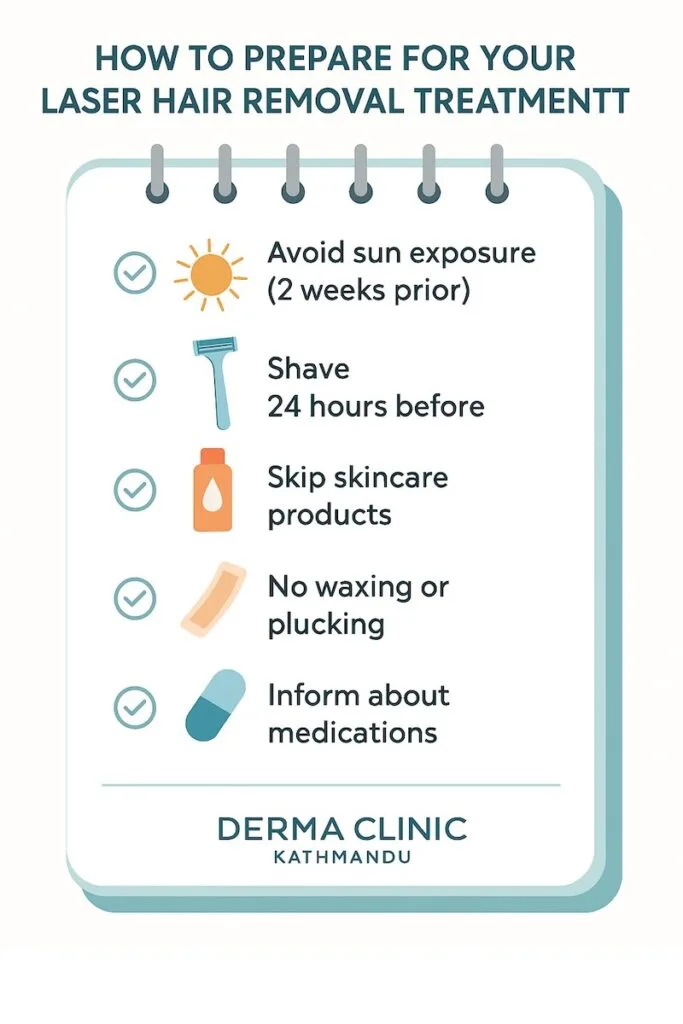
1. Stop Waxing, Threading, and Plucking (4 Weeks Prior): The hair root must stay inside the follicle so the laser has a target to heat. Shaving is completely fine during this 4-week window.
2. Shave 12 to 24 Hours Prior: Shave the treatment zone the day before your visit so laser light goes straight into the root beneath the skin instead of burning surface hair.
3. Avoid Sun Tanning & Pause Active Creams: Keep the area out of direct sun for 2 weeks prior. Pause retinol, tretinoin, adapalene, and glycolic/salicylic acid products on the target area 5 to 7 days before your session.
After Your Appointment (Post-Care)
1. Soothe & Cool: Mild redness and tiny goosebump-like swelling around the hair pores are normal for a few hours after treatment. Apply cool compresses or soothing cream as advised.
2. Skip Heat for 48 Hours: Avoid hot showers, steam rooms, saunas, swimming pools, and heavy workouts for 24 to 48 hours.
3. Daily Broad-Spectrum Sunscreen: Apply SPF 30 to SPF 50+ sunscreen daily on exposed areas. For long-term maintenance tips, read our laser hair removal touch-up guide.
Suitability, Contraindications & Treatment Limitations
During your consultation, Dr. Utsav Sharma screens for three categories of clinical factors to make sure laser hair reduction is both safe and worthwhile for you:
1. When to Postpone
We postpone treatment if you have an active sunburn or fresh tan, an active skin infection (such as a cold sore or bacterial infection in the area), open cuts, or during pregnancy (deferred as a standard precaution).
2. Individualized Review
Requires careful dermatologist evaluation and modified settings if you have a history of keloid scarring, vitiligo or psoriasis, photosensitizing medications, or tattoos in the treatment zone (which must be covered and bypassed).
3. Hair Color Limitations
Not a safety risk, but a biological limitation: white, grey, blonde, or red hairs do not contain enough dark melanin pigment to absorb laser light and will not respond effectively[1].
When to Contact the Clinic Immediately After Treatment
While mild warmth and redness around hair pores normally settle within 2 to 24 hours, please contact Derma Clinic immediately at +977-9801358600 if you notice: persistent burning pain lasting longer than 24 hours, fluid-filled blisters or crusting, signs of skin infection (pus or spreading tenderness), or unexpected dark or light patches so Dr. Utsav Sharma can provide prompt medical care.
Frequently Asked Questions About Laser Hair Reduction
What is laser hair reduction and how does it work?
Laser hair reduction uses selective photothermolysis—concentrated light energy is absorbed by dark melanin pigment inside hair follicles and converted into heat that disables the follicle’s growth center. Our multi-wavelength diode platform emits nominal 755nm, 808nm, and 1064nm wavelengths simultaneously to target superficial, medium, and deep hair roots.
How many sessions do I need and what results are realistic?
Most patients require an initial course of 6 to 8 sessions (spaced 4 to 6 weeks apart for the face and 6 to 8 weeks apart for the body) to achieve substantial long-term hair reduction. Because biological response varies with hair thickness, skin tone, and hormonal status, some patients—especially women with PCOS facial hair—require 8 to 10+ sessions and periodic maintenance treatments.
Is laser hair reduction safe for Nepali skin tones?
When calibrated and supervised by a board-certified dermatologist, laser hair reduction is performed safely across Nepali skin tones (Fitzpatrick Types III to V). Because no laser eliminates the possibility of thermal side effects on darker skin, Dr. Utsav Sharma adjusts pulse duration, fluence (J/cm²), and continuous sapphire contact cooling to help reduce the risk of thermal injury.
What areas can be treated and what are the prices in Kathmandu?
We treat almost any facial or body zone: upper lip (NPR 3,000), upper lip and chin (NPR 5,000), bikini area (NPR 5,000), bilateral underarms (NPR 6,000), full face (NPR 8,000), pilonidal sinus adjunct care (NPR 8,000), full hands (NPR 10,000), full legs (NPR 12,000), and whole-body sessions (NPR 25,000). View our full laser hair removal prices page for package details.
Does laser hair reduction work on white, grey, or blonde hair?
No. Laser hair reduction targets melanin pigment inside the hair shaft. White, grey, blonde, and red hairs lack sufficient dark pigment to absorb laser heat and respond poorly to treatment.
Is the procedure painful?
With continuous sapphire contact cooling and chilled ultrasound gel, most patients feel only a mild warm pinprick or light rubber-band snap sensation. Topical numbing cream can be applied prior to treating sensitive areas like the upper lip or bikini line.
How does laser hair reduction help with Pilonidal Sinus?
While an active pilonidal abscess requires surgical or medical drainage, adjunctive laser hair reduction of the natal cleft and lower back disables the coarse hairs that can burrow into skin pits or surgical scars—helping reduce the risk of long-term recurrence after healing.
Why do some patients need a maintenance session every 1 to 2 years?
Laser treatment disables follicles that are active during your initial course, but hormonal changes, aging, or conditions like PCOS can stimulate previously dormant vellus follicles over time. An occasional maintenance touch-up session keeps new growth in check.
Scientific References and Medical Resources
All clinical statements, selective photothermolysis principles, and safety protocols in this guide are supported by the following medical references:
- American Academy of Dermatology (AAD): Laser Hair Removal: FAQs, Preparation, Expected Outcomes, and Potential Side Effects. American Academy of Dermatology Association. aad.org/public/cosmetic/hair-removal/laser-hair-removal-faqs (Accessed November 2026).
- U.S. Food and Drug Administration (FDA): Removing Hair Safely. FDA Consumer Updates. fda.gov/consumers/consumer-updates/removing-hair-safely (Accessed November 2026).
- DermNet New Zealand: Hair Removal Techniques, Selective Photothermolysis & Cutaneous Laser Principles in Dermatology. DermNet NZ Trust. dermnetnz.org/topics/hair-removal-techniques (Accessed November 2026).
- American Society of Colon and Rectal Surgeons (ASCRS): The American Society of Colon and Rectal Surgeons Clinical Practice Guidelines for the Management of Pilonidal Disease (PMID: 30640830). Dis Colon Rectum. 2019 Feb;62(2):146-157. pubmed.ncbi.nlm.nih.gov/30640830/.
Derma Clinic Pvt. Ltd. (Basundhara Chowki)
Address: 4th Floor, Bishal Bhawan, Basundhara Chowki (Near Petrol Pump), Ring Road, Kathmandu 44600, Nepal
Consultation & Laser Hours: Sunday to Friday, 9:00 AM – 7:00 PM (Closed on Saturdays)
Direct Telephone: +977-9801358600 / +977-1-5918555
Email: info@dermaclinic.com.np
Explore Our Complete Laser Guides
• Laser Hair Removal Prices & Package Calculator
• How to Prepare for Your Laser Hair Removal Session
• When & Why Maintenance Touch-Up Sessions Are Needed
• Book a Dermatologist Laser Consultation Online