
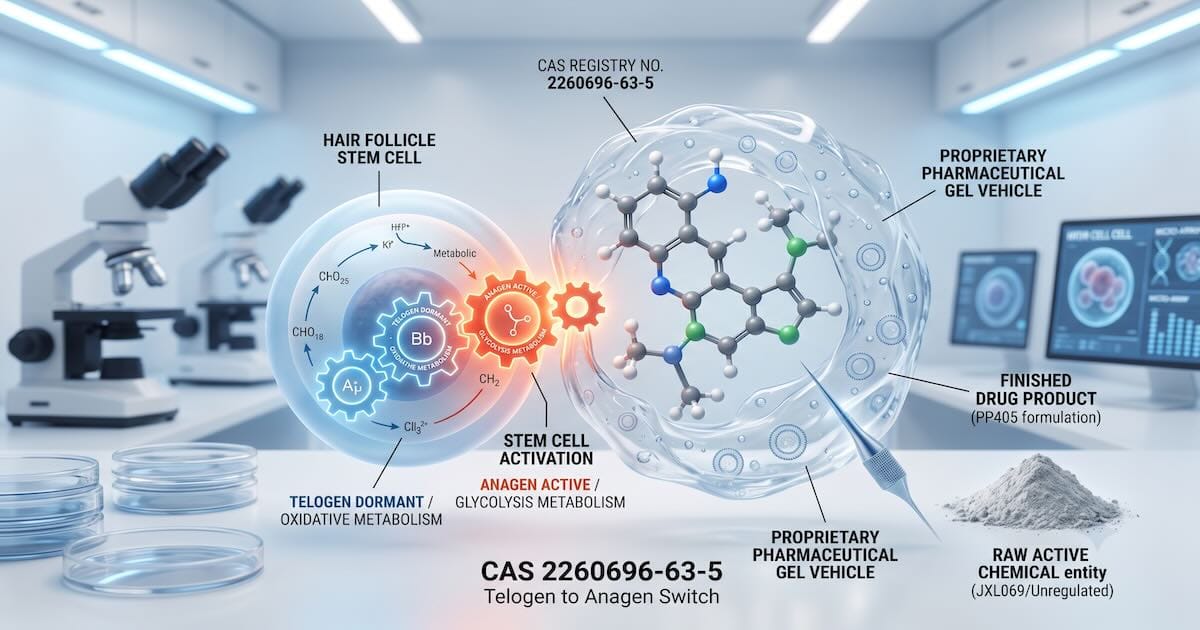
The search for a truly regenerative hair loss drug has led researchers to explore pathways beyond traditional hormonal suppression and vasodilation. A common and pressing question in global hair-loss research communities is whether the highly anticipated investigational candidate PP405 is the exact same active ingredient as the research chemical JXL069. Based on globally recognized chemical identifiers, the evidence suggests that Suvomipic (the nonproprietary name for PP405) and JXL069 refer to the same raw active ingredient.
However, establishing a shared chemical identity is only the first step in pharmaceutical science. This shared identity does not establish that unapproved, unregulated products marketed online as JXL069 provide the safety, efficacy, or pharmaceutical equivalence of the highly controlled clinical formulation developed by Pelage Pharma. To fully understand the distinction, it is necessary to examine the underlying biology, the rigorous clinical trial process, and the strict regulatory standards that govern modern dermatology.
JXL069 vs PP405: Clarifying the Chemical Identity
To answer the question objectively, one must look at global chemical registries. The Chemical Abstracts Service (CAS) assigns a unique numerical identifier to every registered chemical substance. Available public chemical listings use the CAS Registry Number 2260696-63-5 to identify JXL069.
Simultaneously, the WHO INN (World Health Organization International Nonproprietary Name) listing details chemical identifying information corresponding to that exact same CAS Registry Number for a compound named Suvomipic. Suvomipic is the official nonproprietary name assigned to the active entity within PP405. Therefore, the evidence confirms that JXL069 and Suvomipic (PP405) are the same baseline molecule.
The Formulation Difference: Why a Molecule is Not a Drug
Confirming the same chemical entity does not prove you have the same finished drug product. The distinction between a raw compound and a carefully formulated topical gel is monumental in dermatology. A matching CAS number cannot verify the purity, stereochemical profile, precise concentration, necessary excipients, shelf stability, or lack of heavy metal contaminants in an online product.
More importantly, the skin acts as a highly effective barrier. A raw chemical dissolved in rudimentary solvents at home lacks the sophisticated pharmaceutical vehicle designed by Pelage Pharma to penetrate the stratum corneum and deliver the active ingredient precisely to the hair follicle bulge where stem cells reside. Without proper formulation, a molecule remains biologically inert on the surface of the skin. For those seeking professional diagnostics before pursuing any treatment, comprehensive hair loss blood tests can help identify underlying deficiencies or hormonal imbalances.
The Science: Mechanism of Action (MPC Inhibition)
To understand why this specific hair loss drug candidate is generating so much clinical interest, one must understand the biology of the hair follicle stem cell. In conditions like androgenetic alopecia, hair follicles do not immediately die; instead, the stem cells responsible for initiating new hair growth enter a state of prolonged quiescence (dormancy).
PP405 explores an entirely different biological pathway than conventional treatments. As detailed in foundational preclinical studies (Liu et al., 2021), researchers designed the molecule to act as a Mitochondrial Pyruvate Carrier (MPC) inhibitor.
Shifting Cellular Metabolism
Under normal resting conditions, cells metabolize glucose into pyruvate, which is transported into the mitochondria via the MPC to produce energy. Suvomipic blocks this transport mechanism. When the MPC is inhibited, pyruvate cannot enter the mitochondria and is instead converted into lactate in the cell’s cytoplasm. This metabolic shift—specifically the sudden spike in local lactate production—acts as a powerful biological signal.
This lactate burst “wakes up” the quiescent stem cells in the hair follicle bulge, prompting them to begin rapidly dividing and initiating a new anagen (growth) phase. This unique regenerative mechanism operates completely independently of the hormonal pathways targeted by traditional 5-alpha reductase inhibitors. If you are experiencing sudden, patchy hair loss rather than genetic thinning, it is crucial to seek a proper diagnosis, as conditions like alopecia areata require entirely different immunomodulatory interventions.
Clinical Trial Timeline and Progress
The journey from a promising molecule to an approved hair loss drug requires rigorous, multi-phase human testing. Pelage Pharma has been methodically advancing PP405 through this stringent clinical trial process.
Phase 1: Establishing Baseline Safety
Before testing for efficacy, Phase 1 trials are conducted primarily to evaluate safety, tolerability, and pharmacokinetics in healthy volunteers. Initial Phase 1 studies for PP405 demonstrated that the topical formulation was generally well-tolerated, paving the way for targeted efficacy studies in populations actively experiencing hair loss.
Phase 2a: Efficacy and Proof of Concept (NCT06393452)
Pelage Pharma recently shared preliminary data from a randomized, multicenter, double-blind, vehicle-controlled Phase 2a study of PP405 in adults with androgenetic alopecia (NCT06393452). The study enrolled 78 participants, who applied either PP405 0.05% topical gel or a plain vehicle gel once daily to the scalp.
The study’s blinded period required 28 days of strict daily treatment. After this initial phase, participants assigned to the vehicle control group became eligible for a three-month open-label extension using the active PP405 gel. The primary endpoints focused on treatment-related adverse events and local dermal tolerability, while researchers tracked plasma pharmacokinetics as a secondary outcome.
In mid-2025, Pelage Pharma reported exploratory week-8 hair-density results in a defined subgroup. At week 8, 31% of men with a higher degree of hair loss applying PP405 achieved more than a 20% increase in hair density, compared to 0% in the vehicle-control group. It is essential to understand that this represents an exploratory, company-reported early result in a specific subset of patients, rather than a guaranteed response rate for every individual. To dive deeper into the background of this clinical candidate, read our comprehensive overview of PP405.
Safety, Tolerability, and Clinical Limitations
A critical aspect of any topical hair loss drug is avoiding systemic absorption—meaning the drug should stay localized in the scalp rather than entering the bloodstream, where it could cause unintended side effects. Pelage Pharma emphasized that investigators detected zero PP405 in the blood plasma samples of participants during the Phase 2a study period.
While the absence of systemic absorption is a highly promising safety signal, medical professionals rely on long-term data. A short Phase 2a study lasting only 28 days cannot definitively prove long-term safety, durable efficacy over years of use, or the absolute total absence of rare side effects. Larger, double-blind, placebo-controlled Phase 2b and Phase 3 trials involving hundreds or thousands of patients over 6 to 12 months are necessary to fully characterize the safety profile of Suvomipic.
Regulatory Status: Is PP405 Approved?
No. Medical researchers are actively investigating PP405 for androgenetic alopecia, but it is strictly an unapproved, investigational treatment. Neither the FDA nor any other global regulatory body has approved Suvomipic for commercial use or prescription. The compound must successfully pass the remainder of its clinical trials and undergo a rigorous New Drug Application (NDA) review before it can be legally marketed to the public.
Comparing PP405 to Existing and Emerging Therapies
To place PP405 in context, it is helpful to compare its regenerative approach against established and emerging treatments in the dermatological landscape.
- Finasteride and Dutasteride: These are oral or topical 5-alpha reductase inhibitors that work by reducing the conversion of testosterone into dihydrotestosterone (DHT), the hormone responsible for shrinking follicles in genetically susceptible individuals. While effective at halting progression, they rely on hormonal manipulation, which carries a risk of systemic side effects. PP405, by contrast, operates purely on cellular metabolism without interacting with androgen receptors.
- Minoxidil: Originally developed as a blood pressure medication, topical Minoxidil acts as a vasodilator and potassium channel opener. It effectively prolongs the anagen (growth) phase of the hair cycle but does not directly stimulate the stem cell niche in the same targeted metabolic manner as an MPC inhibitor.
- Clascoterone (Topical Antiandrogen): This is a newer topical therapy that binds directly to the androgen receptors in the scalp, preventing DHT from attaching and causing damage. Patients evaluating how advanced topical treatments stack up should review our detailed clinical breakdown of Clascoterone 5% vs PP405 vs Finasteride.
- GFC Therapy: Growth Factor Concentrate therapy is a modern autologous treatment that utilizes a patient’s own blood platelets to extract highly concentrated growth factors (like PDGF and VEGF). These factors are then injected directly into the scalp to stimulate follicles. Unlike experimental chemicals, GFC therapy is an established, non-surgical procedure available today for tissue regeneration.
- Botanical Serums: For those with mild thinning seeking non-pharmaceutical options, newer cosmetically formulated serums utilizing plant-derived vesicles are entering the market. While not as potent as pharmaceutical drugs, they offer supportive care. You can read our dermatologist review of plant-based hair growth serums for more context.
Why Derma Clinic Does Not Recommend Self-Sourcing JXL069
The internet has made it easier than ever to purchase raw chemical compounds like JXL069 from overseas laboratories. However, research-chemical listings do not qualify as approved drug products. Derma Clinic strongly advises against this practice for several critical reasons:
First, there is zero regulatory oversight regarding Good Manufacturing Practices (GMP). You cannot verify the purity of the powder or the absence of toxic heavy metals left over from the synthesis process. Second, the efficacy of a topical drug is heavily dependent on its vehicle. Pelage Pharma has spent years developing a 0.05% topical gel designed specifically to penetrate human skin safely. Dissolving raw powder into ethanol or propylene glycol at home is inexact, potentially irritating, and highly unlikely to achieve the correct tissue concentrations required for MPC inhibition.
If you are seeking clinical guidance for thinning hair, we strongly recommend booking a comprehensive hair-loss consultation. Our specialists can help you navigate our comprehensive dermatology services to find a verified, evidence-based treatment plan tailored to your specific condition. You can also explore our library of clinical articles for more information on managing skin and hair health.
Frequently Asked Questions
Sources and Medical Review
- World Health Organization (WHO) INN Programme. Proposed INN: List 135. Suvomipic; CAS Registry Number 2260696-63-5. WHO Document Repository.
- ClinicalTrials.gov. Identifier NCT06393452. A Phase 2a, Randomized, Double-Blind, Vehicle-Controlled, Multicenter Study to Evaluate the Safety, Pharmacokinetics, and Efficacy of PP405 Topical Gel in Subjects with Androgenetic Alopecia. View Trial Details.
- Pelage Pharmaceuticals (June 17, 2025). Company press release reporting preliminary exploratory Phase 2a findings for 0.05% PP405. Pelage Pharmaceuticals Press Release.
- Liu X, Flores AA, Situ L, et al. Development of Novel Mitochondrial Pyruvate Carrier Inhibitors to Treat Hair Loss. Journal of Medicinal Chemistry. 2021;64(4):2046–2063. Read the peer-reviewed preclinical study.