
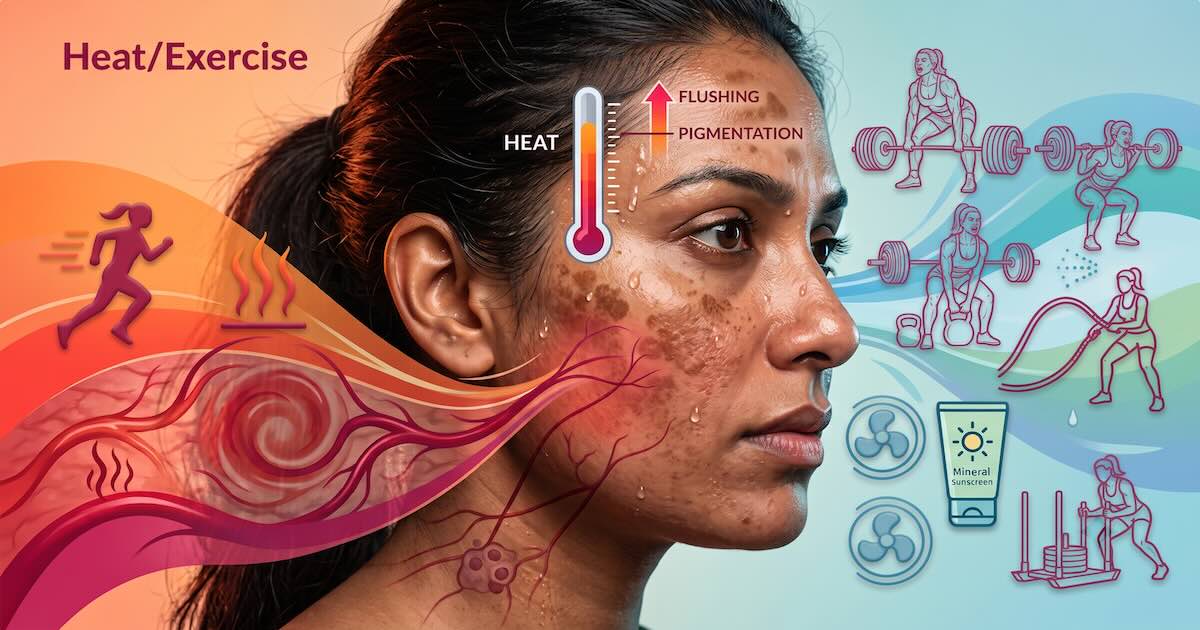
If you suffer from melasma, you likely already know that sunlight is one of the most important environmental triggers. But what happens when you diligently apply your sunscreen, head to the gym for a heavy workout, and still notice your dark patches flaring up?
While ultraviolet (UV) radiation is the most established environmental trigger for melasma, cutting-edge dermatology research reveals it is not the only one. Some people report that hot weather, saunas, hot yoga and intense facial flushing worsen their pigmentation. Heat may be a contributing trigger in susceptible individuals, particularly when it overlaps with UV exposure, visible light, inflammation or hormonal factors.
💡 Key Takeaways
- Heat’s potential role: Experimental models suggest that heat can promote pigment-related signalling without concurrent UV exposure. In daily life, melasma usually reflects overlapping heat, UV, visible-light, hormonal and inflammatory influences.
- Exercise isn’t the enemy: Sweat itself doesn’t cause melasma. However, for some people who repeatedly notice flares after intense exercise, heat and facial flushing may be contributing triggers.
- Management is possible: Cooling breaks and a cooler exercise environment may reduce prolonged overheating and improve comfort; evidence that they prevent melasma flares is limited.
- Targeted treatments: Topical therapy and selected superficial peels may be useful adjuncts in an individualized melasma treatment plan.
Contents
What is Melasma?
Melasma is a chronic, relapsing skin condition characterized by symmetrical brown, grey-brown, or blue-grey hyperpigmentation, typically appearing on the cheeks, forehead, upper lip, and jawline. While it is highly influenced by hormones and genetics, environmental triggers can play an important role in its activity and recurrence.
Can Exercise Worsen Melasma?
Exercise does not directly “cause” melasma to form. Regular cardiovascular exercise is essential for systemic health, and people with melasma generally do not need to avoid exercise solely because of pigmentation.
However, strenuous exercise may aggravate melasma in some susceptible people, particularly when combined with outdoor light exposure or prolonged overheating. As your core body temperature rises, your blood vessels dilate to release heat (facial flushing). Vascular and inflammatory mediators, including VEGF, may contribute to melanocyte activity and pigment persistence in some melasma lesions.
Some patients identify prolonged heat exposure, including hot yoga or saunas, as a personal trigger.
Sweat vs. Heat: What Actually Causes the Flare?
Many patients notice darker skin immediately after a gym session and blame their sweat. The salt and water in sweat do not directly stimulate melanin production.
If your melasma looks immediately darker post-workout, it is often due to a combination of:
- Thermal Stress: Experimental models suggest heat may activate TRPV3 calcium channels in the skin, which can promote pigment-related signalling.
- Erythema: Temporary facial redness and blood pooling make existing brown patches temporarily look darker.
- Compromised Protection: Sweat dilutes and washes away your sunscreen, leaving you vulnerable to incidental UV and visible light if you are exercising outdoors.
- Friction: Aggressively wiping sweat away with a gym towel causes friction-induced inflammation.
Comparing Environmental Triggers: UV vs. Light vs. Heat
Understanding how different elements trigger your skin is crucial for management.
| Trigger Type | Common Sources | Biological Impact on Melasma |
|---|---|---|
| Ultraviolet (UV) Rays | Direct sunlight, tanning beds | Promotes melanogenesis through UV-induced cellular stress, inflammation and activation of pigment-related pathways. UV exposure is among the best-established environmental triggers for melasma. |
| Visible Light | Sunlight (the most significant real-world source) | Induces prolonged hyperpigmentation, especially in Fitzpatrick skin types III-VI (darker skin tones). A tinted sunscreen containing iron oxides can provide additional protection. |
| Thermal Stress (Heat) | Intense exercise, hot yoga, saunas, cooking over a stove | May cause temporary vasodilation (flushing) and has been shown in experimental models to activate pigment-signaling pathways. |
Prevention Checklist for Safe Workouts
You can maintain your fitness routine while protecting your skin. Consistent photoprotection, practical trigger management and an appropriate skincare routine all contribute to melasma control.
- Optimize Timing: For outdoor exercise, choose times when the UV Index is lower, seek shade where practical, and avoid prolonged outdoor exposure during the day’s strongest sun.
- Avoid Prolonged Overheating: If heat consistently appears to trigger your melasma, consider reducing prolonged overheating from hot yoga, saunas, steam rooms and poorly ventilated exercise spaces.
- Cool Down Gradually: Cooling breaks and a cooler exercise environment may reduce prolonged overheating and improve comfort, though evidence that they specifically prevent melasma flares is limited.
- Wear High-Protection Sunscreen: For outdoor exercise, choose a broad-spectrum, water-resistant SPF 50+ sunscreen with strong UVA protection. A tinted formula containing iron oxides can provide additional protection against visible light, which may be particularly helpful for melasma. Choose a mineral, organic or hybrid formula based on its protection, comfort, shade match and your ability to apply and reapply it consistently.
- Hydrate Effectively: Stay hydrated during exercise for general health and heat tolerance.
Clinical Treatment Options for Melasma
Melasma is often treatment-resistant because it has multiple contributing factors, including pigment production, light exposure, inflammation, hormones and, in some patients, vascular features.
Evidence-Based Topical Treatments
Photoprotection and topical therapy are the foundation of treatment. Choice of treatment should consider pigmentation pattern, skin sensitivity, pregnancy status, previous irritation and risk of post-inflammatory hyperpigmentation.
| Ingredient | Mechanism of Action | Clinical Notes |
|---|---|---|
| Hydroquinone | Inhibits tyrosinase, reducing melanin production. | The gold standard. Must be used under medical supervision in time-limited cycles. |
| Triple-Combination Cream | Combines hydroquinone, tretinoin, and a mild corticosteroid. | Among the best-supported topical options for moderate to severe melasma; must be monitored by a dermatologist. |
| Tranexamic Acid | May influence pigmentary, inflammatory and vascular pathways. | May be used as an adjunct; response varies and it is not a specific treatment for heat-induced melasma. |
| Azelaic Acid (15%-20%) | Anti-inflammatory; selectively targets hyperactive pigment cells. | May be useful for maintenance treatment, particularly when hydroquinone is not tolerated or when a gentler anti-inflammatory option is appropriate. |
| Kojic Acid & Niacinamide | Kojic acid inhibits tyrosinase, while niacinamide may reduce melanosome transfer from melanocytes to surrounding skin cells. | May be useful supportive ingredients in combination formulations; tolerability varies between patients. |
Oral Medications & Adjunctive Therapies
Oral TXA may improve melasma in selected patients as an off-label adjunct, following careful assessment of thromboembolic and other clinical risks. Oral TXA is not suitable for everyone and should generally be avoided in patients with active or previous thromboembolic disease, significant clotting risk, or combined hormonal contraceptive use.
Additionally, superficial chemical peels (like Mandelic or low-strength Glycolic acid) may help promote controlled exfoliation and support topical treatment when selected carefully. Deep or aggressive peels can cause substantial chemical injury and inflammation, increasing the risk of PIH or melasma worsening.
Frequently Asked Questions
Can heat make melasma worse without sun exposure?
Heat may worsen melasma in some people. Experimental models suggest that heat can promote pigment-related signalling without concurrent UV exposure. In daily life, melasma usually reflects overlapping heat, UV, visible-light, hormonal and inflammatory influences.
Should I stop exercising if I have melasma?
No. Exercise is beneficial for overall health. If heat appears to be a personal trigger, try cooler exercise environments, shaded routes, and reliable outdoor photoprotection.
Can I run outside with melasma?
Yes, but precautions are helpful. Choose times when the UV Index is lower, seek shade, and wear a broad-spectrum, sweat-resistant tinted sunscreen and a wide-brimmed hat to protect against UV rays and visible light.
What is the best sunscreen for melasma in hot weather?
For outdoor exercise, choose a broad-spectrum, water-resistant SPF 50+ sunscreen with strong UVA protection. A tinted formula containing iron oxides can provide additional protection against visible light. Choose a mineral, organic or hybrid formula based on its protection, comfort, shade match and your ability to apply and reapply it consistently.
Is melasma permanent?
Melasma can often improve substantially, but it is chronic and relapse is common. Long-term management and relapse prevention involve strict environmental protection and maintenance therapies.
Expert Melasma Treatment at Derma Clinic
At Derma Clinic Kathmandu, I begin melasma treatment with a comprehensive, individualized assessment. I evaluate your specific pigmentation pattern, lifestyle triggers, and previous treatment responses to build a customized protocol focused on combination therapy.
If you believe heat, outdoor exercise or facial flushing is contributing to recurrent pigmentation, professional clinical intervention is the safest way to achieve long-term management and relapse prevention.
References & Clinical Data
- American Academy of Dermatology Association (AAD). Melasma: Diagnosis and treatment.
- Zhang L, Zeng H, Jiang L, et al. Heat promotes melanogenesis by increasing the paracrine effects in keratinocytes via the TRPV3/Ca²⁺/Hh signaling pathway. iScience. 2023;26(5):106749. https://doi.org/10.1016/j.isci.2023.106749
- Masub N, Nguyen JK, Austin E, Jagdeo J. The Vascular Component of Melasma: A Systematic Review of Laboratory, Diagnostic, and Therapeutic Evidence. Dermatologic Surgery. 2020;46(12):1642–1650. https://doi.org/10.1097/DSS.0000000000002770
- Morgado-Carrasco D, et al. Melasma: The need for tailored photoprotection to improve clinical outcomes. Photodermatology, Photoimmunology & Photomedicine. 2022;38(6):515–521. https://doi.org/10.1111/phpp.12783
- Godse K, et al. Oral Tranexamic Acid for the Treatment of Melasma: Evidence and Experience-Based Consensus Statement from Indian Experts. Indian Journal of Dermatology. 2023;68(2):178–185. https://doi.org/10.4103/ijd.ijd_266_22