
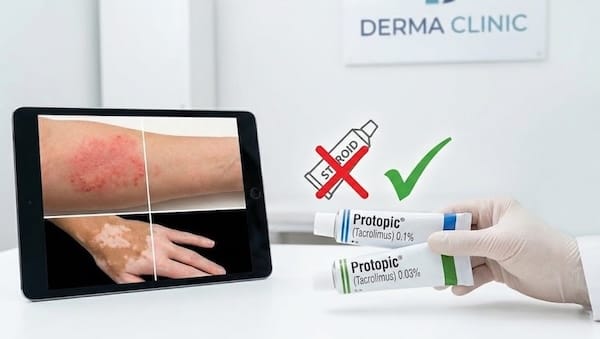
Steroid-Free Powerhouse for Eczema, Vitiligo, & Rosacea—Dermatologist Insights on Strengths & Research
Discover FDA-approved topical tacrolimus (Protopic) for atopic dermatitis, plus off-label uses for vitiligo, rosacea, and psoriasis. Compare 0.1% vs 0.03%, explore the latest trials, and learn about proactive therapy. Your ultimate 2026 guide for long-term skin relief.
Introduction: Escape the Steroid Trap
Chronic skin conditions like atopic dermatitis trap many patients in a frustrating cycle of steroid overuse. This often leads to skin thinning (atrophy), rebound flares, or eventual resistance to the medication. Topical Tacrolimus (brand name Protopic), a calcineurin inhibitor ointment, breaks this cycle. It modulates the immune response without the side effects of steroids, making it the ideal choice for long-term use on sensitive areas like the face, eyelids, and groin.
This comprehensive 2026 guide verifies FDA approvals, explores emerging research, and details over 10 off-label uses—vital information for patients seeking advanced skincare. Whether you are battling eczema flares or seeking repigmentation for vitiligo, discover why dermatologists call this the “miracle molecule.”
Watch: Topical Tacrolimus Explained
FDA Approvals & Available Strengths
The FDA approves topical tacrolimus ointment solely for moderate to severe atopic dermatitis in non-immunocompromised patients. It is designated as a second-line therapy, meaning it is prescribed when other treatments (like steroids) have failed or are not tolerated.
It is available in two strengths:
- 0.03% Ointment: For children (ages 2–15) and adults with sensitive skin.
- 0.1% Ointment: For adults (16+) and more resistant lesions.
Proactive Maintenance:
Current guidelines support applying the ointment to previously affected areas twice weekly to prevent flares. The ointment’s greasy base is intentional—it hydrates the skin barrier better than creams, though it may feel heavy on facial skin. Note: There are currently no FDA-approved commercial gels or creams.
Quick Reference: Dosage & Strength
| Patient Group | Indication | Strength | Frequency |
| Children (2–15 years) | Atopic Dermatitis | 0.03% Ointment | Twice Daily |
| Adults (16+ years) | Atopic Dermatitis | 0.03% or 0.1% Ointment | Twice Daily |
| All Ages (Maintenance) | Flare Prevention (Proactive) | 0.03% or 0.1% | Twice Weekly |
Emerging Research: Higher Strengths & Innovations
While the standard 0.1% ointment penetrates eczema well, it often struggles with the thick, scaly plaques of psoriasis on elbows or knees.
- High-Strength Trials: Research (including studies from Ortonne et al.) has tested 0.3% gel and 0.5% cream for plaque psoriasis. These formulations showed significant improvement (up to 55.6% clearance in trials), outperforming some standard therapies. While not yet commercially available, compounding pharmacies can sometimes prepare these higher strengths for resistant cases under strict dermatologist supervision.
- Nanotechnology: New research into Solid Lipid Nanoparticles (SLN) aims to enhance skin penetration while reducing the greasy feel and systemic absorption. These advancements signal a “new frontier,” potentially expanding tacrolimus use to deep dermal conditions like Lupus without steroid risks.
The “Hidden Menu”: Proven Off-Label Uses
Off-label prescribing leverages the unique safety profile of tacrolimus: it does not cause skin atrophy. This makes it the “gold standard” for treating thin, sensitive skin.
- Vitiligo (Pigment Restorer):Tacrolimus inhibits the immune attack on melanocytes. It is most effective on the face and neck.
- Pro Tip: Repigmentation speed effectively doubles (up to 87% efficacy in responsive areas) when paired with NB-UVB phototherapy or controlled daily sun exposure (approx. 15 mins).
- Steroid-Induced Rosacea / Perioral Dermatitis:It acts as a “bridge” during steroid withdrawal, calming redness and preventing the dreaded rebound flare on flushed facial skin.
- Inverse Psoriasis:Clears painful lesions in intertriginous areas (armpits, groin, under breasts) where potent steroids are dangerous.
- Lichen Planus (Oral & Genital):Used to soothe erosions in the mouth (often as a compounded rinse) and as maintenance for Genital Lichen Sclerosus to prevent scarring.
- Seborrheic Dermatitis:Tackles stubborn facial “dandruff” (eyebrows, nasolabial folds) that is unresponsive to antifungal creams.
Note: Other potential uses include Granuloma Annulare and Alopecia Areata. Always consult a dermatologist for personalized application protocols.
0.1% vs. 0.03%: The Efficacy Debate
- The Power Difference: Meta-analyses confirm that 0.1% clears thick, lichenified rashes significantly faster in adults.
- The Case for 0.03%: The lower strength shines for eyelids (the thinnest skin on the body) and for the first few days of treatment to avoid stinging.
- The Strategy: Both strengths reduce inflammation effectively. The famous “Tacrolimus Burn” (a sensation of heat/stinging in the first 3 days) is generally milder with 0.03%, allowing patients to build tolerance before stepping up to 0.1% if needed. For maintenance, 0.03% is often sufficient to keep the skin clear.
Latest Clinical Insights (2024-2026)
- Pediatric Efficacy: Recent analyses continue to challenge the “mild steroids first” paradigm. Data suggests that Tacrolimus 0.03% can outperform Hydrocortisone 1% in children by better reducing inflammatory biomarkers (such as TARC) and preventing relapse longer.
- Lymphedema Research (TACLE): The ongoing TACLE trials are evaluating Tacrolimus for breast cancer-related lymphedema. The hypothesis is that reducing local inflammation can prevent the fibrosis (scarring) that causes chronic swelling. While results are pending, this highlights the drug’s potential beyond simple rashes.
Safety Profile & Key Warnings
Tacrolimus boasts a strong safety record for intermittent long-term use (studies exist spanning 4–10 years), with no loss of potency over time (tachyphylaxis).
- Contraindications: Avoid in Netherton’s Syndrome (due to excessive systemic absorption), active infections (Herpes Simplex, Impetigo), and Pregnancy (Category C—use only if benefits clearly outweigh risks).
- The “Alcohol Flush”: A unique reaction where the face becomes red and hot after consuming alcohol. FDA labeling notes this occurs in 3–7% of patients (due to ALDH inhibition). It is harmless and typically resolves within 20–60 minutes.
- Black Box Warning: The label carries a warning regarding a theoretical risk of lymphoma based on high-dose animal studies and oral transplant data. However, extensive long-term human studies have not found a causal link with topical use.
Frequently Asked Questions (FAQ) About Topical Tacrolimus
1. Is Topical Tacrolimus a steroid?
No, absolutely not. Tacrolimus is a Topical Calcineurin Inhibitor (TCI). It works differently from steroids by targeting specific immune cells (T-cells) without causing the side effects associated with long-term steroid use, such as skin thinning (atrophy), stretch marks, or spider veins. This makes it safe for long-term use on sensitive areas like the face, eyelids, and groin.
2. Why does my skin burn when I apply it?
A burning, stinging, or warming sensation is the most common side effect, affecting about 40–50% of patients during the first few days. This happens because the medication releases a chemical called Substance P from your nerve endings.
- Pro Tip: Do not stop! The burning usually disappears after 3 to 4 days of continuous use as your skin builds tolerance. You can reduce the stinging by storing the tube in the fridge before application or ensuring your skin is completely dry (wait 20 minutes after washing) before applying.
3. Can I use Tacrolimus on my eyelids?
Yes. Unlike topical steroids, which can increase the risk of glaucoma or cataracts if used near the eyes for long periods, Tacrolimus does not raise eye pressure. It is considered the treatment of choice for eyelid eczema. However, be careful not to get the ointment inside the eye, as it will cause stinging.
4. Which strength should I use: 0.1% or 0.03%?
- 0.1% is generally prescribed for adults (16+) with moderate-to-severe conditions or thicker skin (like the body). It is stronger and works faster.
- 0.03% is FDA-approved for children (ages 2–15) and is often preferred for adults with very sensitive skin (like the face or genitals) to minimize stinging.
- Always follow your dermatologist’s prescription; they may start you on a lower strength to build tolerance before switching to the higher one.
5. Can I drink alcohol while using Protopic?
You can, but be aware of the “Alcohol Flush.” About 15–20% of users experience sudden redness, heat, and flushing on their face if they drink alcohol while using the medication. This reaction is harmless and temporary, but it can be socially embarrassing. It typically stops happening after 3–4 weeks of consistent use.
6. Does Topical Tacrolimus cause cancer?
This is a common fear due to a “Black Box Warning” added by the FDA in 2006. However, this warning was largely based on animal studies using massive doses and data from transplant patients taking oral (pill) Tacrolimus.
- The Reality: Extensive long-term studies in humans (spanning over 10 years) have not found a causal link between topical Tacrolimus and an increased risk of lymphoma or skin cancer. Dermatologists consider it safe when used as directed.
7. Can I go in the sun while using it?
You should practice sun safety. While Tacrolimus does not cause sunburns like some acne creams, the manufacturer recommends minimizing unprotected sun exposure.
- Exception for Vitiligo: For Vitiligo patients, dermatologists often prescribe controlled sun exposure (e.g., 15 minutes) or UVB phototherapy in combination with Tacrolimus to stimulate repigmentation. Always ask your doctor for specific advice regarding your condition.
8. How long does it take to work?
- For Eczema: You should see significant improvement within 1 week. If there is no improvement after 6 weeks, consult your doctor.
- For Vitiligo: It takes much longer. You may need to use it for 3 to 6 months before seeing pigment return. Patience is key!
9. Can I use it on my child?
Yes, the 0.03% strength is FDA-approved for children aged 2 years and older. It is a preferred alternative to steroids for children who need long-term maintenance therapy, as it does not affect growth or bone density.
10. Can I apply moisturizer with Tacrolimus?
Yes, and you should! Moisturizers help repair the skin barrier. The general rule is to apply your moisturizer first, let it absorb for about 15–20 minutes, and then apply the Tacrolimus ointment. Do not mix them together in your hand before applying, as this dilutes the medication.
Proactive Therapy: Your Next Step
The modern approach to skin disease is shifting from “chasing flares” to preventing them.
Proactive Therapy involves applying Tacrolimus twice weekly to your “problem spots,” even when the skin looks normal. This method is clinically proven to extend remission periods in Eczema and Vitiligo.
Living in Kathmandu?
At Derma Clinic, our specialists tailor Protopic regimens for laser-resistant vitiligo, chronic rosacea, and psoriasis.
- Book a consultation today to discuss if Topical Tacrolimus is the missing piece of your skincare puzzle. Stop the steroid trap—unlock lasting relief.
- Its Easy to Book Online Appointment or Whatsapp US or Call US 9801358600 at Derma Clinic Kathmandu.