
By Dr. Utsav Sharma (MD Dermatology, NMC 7619) | Derma Clinic Kathmandu
Vitamin C reigns as the undisputed skincare powerhouse. From fading dark spots (hyperpigmentation) and boosting collagen to shielding your skin against Kathmandu’s harsh sun, it is the one ingredient nearly every dermatologist recommends.
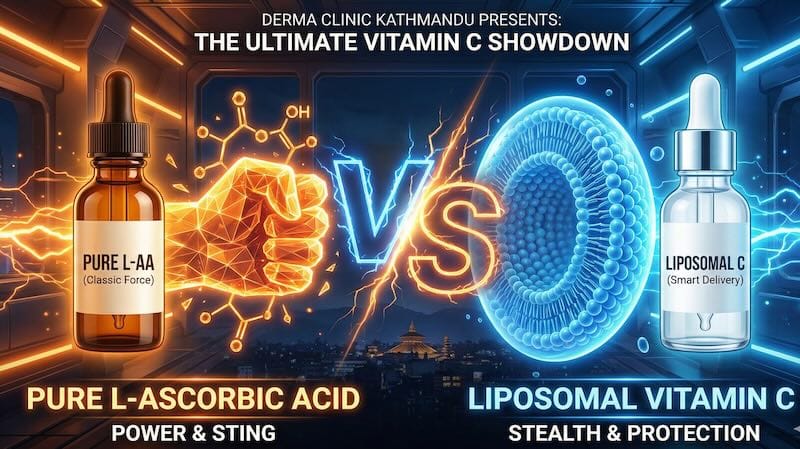
But not all Vitamin C serums are created equal. The two main contenders—Pure L-Ascorbic Acid and Liposomal Vitamin C—deliver results in completely different ways. One uses power; the other uses stealth.
At Derma Clinic Kathmandu, we believe the best product is the one your skin can actually tolerate. This guide compares the science to help you choose the right formula for your skin type.
1. Pure L-Ascorbic Acid: The “Powerhouse” Classic
This is the form most researched by scientists. It is water-soluble and biologically active the moment it touches your skin.
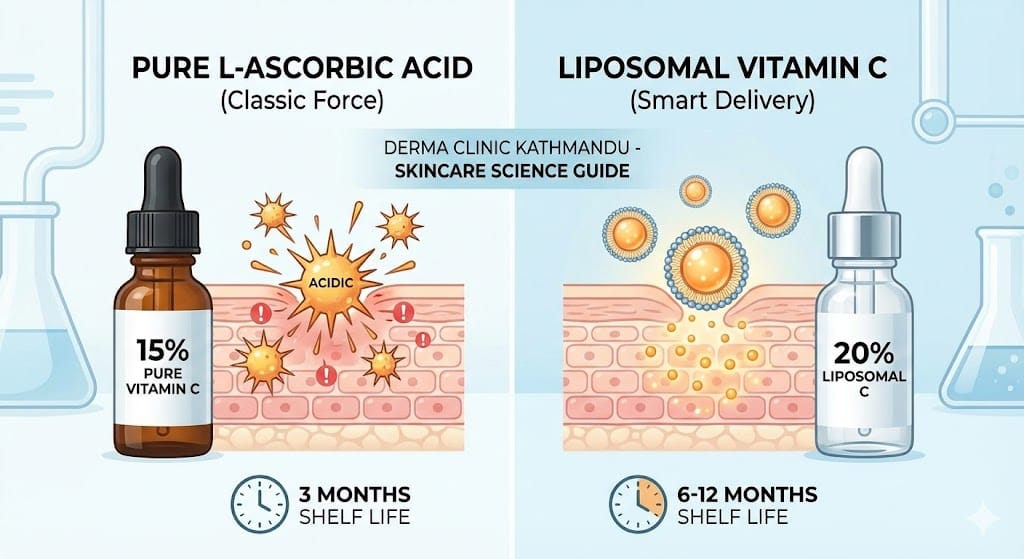
- The Mechanism (Brute Force): Your skin is naturally waterproof. To penetrate it, pure Vitamin C relies on a low pH (2.0–3.5). This acidity momentarily shocks the skin barrier to force the active ingredients inside.
- The Pros: Unmatched potency. It delivers an immediate “glow” and rapid surface exfoliation.
- The Cons: The “sting.” The high acidity can dry out the skin barrier and cause irritation. It is also highly unstable—oxidizing from clear to brown (and becoming useless) within 3 months of opening.
2. Liposomal Vitamin C: The “Smart” Upgrade
This is the modern evolution of delivery systems, designed to solve the stability issues of the classic formula.
- The Mechanism (The Trojan Horse): Instead of using acid to break in, the Vitamin C is encapsulated in liposomes—microscopic fat spheres that mimic your own skin cells. The skin recognizes these spheres as “friendly” and allows them to merge with the barrier, releasing the vitamin deep inside the dermis.
- The Pros: It bypasses surface irritation entirely, making it safe for sensitive skin or Rosacea. The lipid layer also protects the Vitamin C from air, keeping it stable for 6–12 months.
- The Cons: You may not get that “instant” acidic exfoliation glow, as it works primarily in the deeper layers.
Head-to-Head: The Critical Differences
📊 Round 1: Stability & Shelf Life
Why your expensive serum turns brown.
| Feature | Pure L-AA (15%) | Liposomal Vitamin C (20%+) |
| Main Enemy | Light, Air, Heat (Oxidizes rapidly) | Protected by Lipid Shield |
| Shelf Life (Open) | 3 Months (Strict) | 6–12 Months |
| Required Bottle | Dark Glass / Air-tight | Flexible (Any stable bottle) |
| Visual Check | Clear = Good; Yellow/Brown = Bad | Milky/Opaque = Normal |
🔬 Round 2: Efficacy & Absorption
How deep does it actually go?
| Feature | Pure L-AA | Liposomal Vitamin C |
| Concentration | 10–20% (Above 20% wastes absorption) | 20–30% (Higher doses tolerated well) |
| Penetration Style | pH-dependent (Needs acidity) | Lipid-fusion (pH independent) |
| Target Zone | Surface Brightness & Epidermis | Deep Dermis (Collagen Production) |
🧖♀️ Round 3: Tolerance & Feeling
Will it sting?
| Feature | Pure L-AA | Liposomal Vitamin C |
| Sensation | Tingling, “Spicy”, or Stinging | Soothing, Hydrating |
| Best Skin Type | Oily, Resilient, Thick Skin | Dry, Sensitive, Rosacea-Prone |
| Routine Ease | Hard (Risky with Retinols/Acids) | Easy (Layers well with others) |
The Benefits Timeline: When Will I See Results?
Vitamin C is a marathon, not a sprint. Consistency is key.
| Timeline | What You Will See |
| Immediate | Antioxidant protection begins. Neutralizes free radicals from UV rays instantly (layer under sunscreen!) |
| 2–4 Weeks | Skin tone appears more even; the famous “Vitamin C Glow” sets in. |
| 4–8 Weeks | Dark spots and post-acne marks (PIH) begin to fade visibly. |
| 3–6 Months | Collagen production ramps up; fine lines soften and texture improves. |
How to Avoid “The Orange Face”: Usage Guide
1. The Golden Rule of Layering
Always apply Vitamin C on clean, dry skin directly after washing.
Order: Cleanser → Vitamin C → Moisturizer → Sunscreen.
2. Common Ingredient Clashes
| Ingredient | The Risk | The Solution |
| Retinol | High Irritation / Oxidation | Use Vitamin C in AM, Retinol in PM. |
| AHAs / BHAs | Barrier Damage (Burn) | Alternate days or use in PM. |
| Benzoyl Peroxide | Cancels out Vitamin C | Do not use together. |
Frequently Asked Questions (FAQ)
Which Vitamin C is best for beginners?
For absolute beginners, Liposomal Vitamin C is the safest starting point. Because it releases slowly and lacks the high acidity of pure L-Ascorbic Acid, it minimizes the risk of “purging” or irritation while still delivering brightening benefits.
How do I know if my Vitamin C serum has gone bad?
Watch the color.
- Pure L-Ascorbic Acid: Starts clear or very pale yellow. If it turns dark yellow, orange, or brown, it has oxidized. It is no longer effective and may actually cause inflammation—throw it away.
- Liposomal Vitamin C: Usually has a milky or opaque appearance. If it smells rancid or separates, discard it.
Is it normal for Vitamin C to sting?
A mild tingling sensation is common with pure L-Ascorbic Acid due to its low pH. However, it should never burn or leave your skin red for hours. If it does, your moisture barrier may be compromised.
Can Vitamin C remove old acne scars?
Yes, but it takes time. Vitamin C helps fade Post-Inflammatory Hyperpigmentation (PIH)—the dark spots left behind by acne—by inhibiting melanin production.
Should I keep my serum in the fridge?
- Pure L-Ascorbic Acid: Yes. The fridge slows down oxidation and extends shelf life.
- Liposomal Vitamin C: Generally no, unless the bottle instructions say otherwise.
Can I use Vitamin C at night?
Yes, but you get the most value by using it in the morning. Vitamin C’s superpower is neutralizing free radicals generated by UV light and pollution.
The Verdict: Which One Should You Buy?
Choose Pure L-Ascorbic Acid If:
- You have tough, oily skin that isn’t easily irritated.
- You want that fast, instant glow.
- You are disciplined enough to finish the bottle in 90 days.
Choose Liposomal Vitamin C If:
- You have sensitive or rosacea-prone skin (80% of users thrive here).
- You need a long shelf life.
- You want deep repair and anti-aging without the sting.
💡 Pro Tip: Don’t waste money on the wrong formula from random online sellers. We stock medically vetted Liposomal Vitamin C at our clinic pharmacy—guaranteed authentic, fresh, and stored at the perfect temperature to ensure results.
🏥 Expert Skin Care in Kathmandu
Still unsure which Vitamin C is right for your pigmentation or acne scars?
Dr. Utsav Sharma (MD Dermatology, NMC 7619) at Derma Clinic Kathmandu specializes in creating medical-grade skincare routines tailored to Nepalese skin types. We analyze your barrier health before prescribing high-strength actives.
📅 Book Your Consultation Today for brighter, healthier skin.
References
- Evaluation of Liposomal Systems. SciELO
- Percutaneous absorption of Vitamin C. PubMed
- Liposomal Delivery Systems in Dermatology. PubMed
- Ex-vivo evaluation of antioxidant delivery. DovePress
- Vitamin C for Sensitive Skin Guide. World of Asaya
- Vitamin C Serums for Sensitive Skin. DRMTLGY
- How Long to See Results. Skincare CRL
- Timelines for Vitamin C Results. Timeless HA
- Topical L-Ascorbic Acid Science. L’Oreal Dermatological Beauty
- How to Store Vitamin C. Vichy USA
- Vitamin C and Sunscreen Layering. Green People
- Layering Actives. World of Asaya
- Ingredients to Avoid with Vitamin C. Derma Essentia