
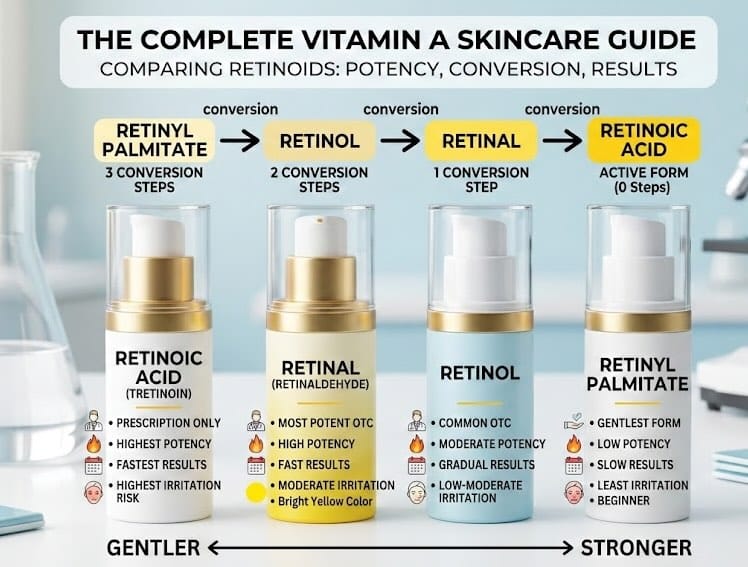
If you have been trying to understand the difference between retinol vs retinal vs tretinoin — and where retinyl palmitate fits in — this guide covers everything you need to know. These four ingredients are all forms of Vitamin A, but they are not the same thing. The difference between them determines how fast your skin responds, how much irritation you might experience, and whether you need a prescription at all.
As a dermatologist in Kathmandu, I often see patients confused by the many forms of Vitamin A. Whether you are treating acne in our humid summers or fixing sun damage from the high-altitude sun, choosing the right retinoid is critical. This guide breaks down Retinol, Retinal, Tretinoin, and Retinyl Palmitate to help you choose the right one for your skin type.
At A Glance: Retinoid Comparison Table
In a rush? Here is the quick breakdown of how these Vitamin A forms compare.
| Feature | Retinoic Acid (Tretinoin) | Retinal (Retinaldehyde) | Retinol | Retinyl Palmitate |
| Strength | ⭐⭐⭐⭐⭐ (Highest) | ⭐⭐⭐⭐ (Very High) | ⭐⭐⭐ (Moderate) | ⭐ (Low) |
| Conversion Steps | 0 (Active Immediately) | 1 Step | 2 Steps | 3 Steps |
| Best For | Severe Acne, Deep Wrinkles | Acne, Faster Anti-Aging | Mild Aging, Beginners | Sensitive Skin |
| Prescription? | Yes | No | No | No |
| Irritation Risk | High | Moderate | Low–Moderate | Low |
The Retinoid Strength Ladder
To understand why Tretinoin is stronger than Retinol, you need to understand the “Conversion Chain.” Your skin only understands Retinoic Acid. Everything else must convert into it.
Retinyl Palmitate → Retinol → Retinal → Retinoic Acid (Active)
- Retinol takes 2 steps to convert. It’s slower but gentler.
- Retinal takes 1 step. It works up to 11x faster than Retinol.
- Tretinoin is already Retinoic Acid. It works immediately.
The 4 Forms Explained
1. Tretinoin (Retinoic Acid)
Best For: Cystic acne, melasma, deep wrinkles.
Status: Prescription Only.
Tretinoin is the gold standard. Because it requires no conversion, it binds directly to skin receptors. In Nepal, it is often prescribed for acne and severe sun damage. However, it carries a high risk of “Retinoid Dermatitis” (redness/peeling) if used incorrectly.
⚠️ Brown Skin Warning: In darker skin tones (Fitzpatrick IV-VI), Tretinoin irritation can cause Post-Inflammatory Hyperpigmentation (dark spots). Always use with moisturizer and SPF.
2. Retinal (Retinaldehyde)
Best For: Acne-prone skin, faster anti-aging results without a doctor visit.
Retinal is the strongest OTC option. It is antibacterial (great for acne) and works significantly faster than retinol. If Retinol didn’t work for you, but Tretinoin was too harsh, Retinal is your “sweet spot.”
3. Retinol
Best For: Beginners, mild texture issues.
The most common form. It is effective but requires patience. It takes longer to see results because of the 2-step conversion process.
4. Retinyl Palmitate
Best For: Extremely sensitive skin, rosacea.
Very gentle. It acts more as an antioxidant protector than a skin resurfacer.
Special Mention: Adapalene vs Tretinoin
Adapalene (Differin) is a synthetic retinoid designed specifically for acne. Unlike Tretinoin, it is stable in sunlight and generally causes less irritation. Use Adapalene if your main concern is acne; use Tretinoin if you want both acne AND anti-aging benefits.
Can’t Tolerate Retinoids? Meet Bakuchiol
If your skin is too sensitive for even Retinyl Palmitate, or if you are pregnant/breastfeeding, look for Bakuchiol. It is a plant-based extract that mimics the collagen-stimulating effects of retinol without the irritation.
How Long Does It Take to Work? (Timeline Table)
Patience is key. Here is the realistic timeline for results:
| Timeframe | What Is Happening to Your Skin |
| Weeks 1–4 | The “Purge” & Adjustment. You may see dry patches or more pimples than usual. This is normal clearing of deep clogs. |
| Weeks 4–8 | Tolerance Building. Irritation subsides. Skin starts feeling smoother. Early acne reduction. |
| Weeks 12+ | Visible Results. “The Retinol Glow.” Fine lines soften, dark spots fade, and collagen production increases. |
| 6 Months+ | Structural Change. Deep dermal thickening and significant improvement in wrinkles/scars. |
Retinol Concentration Guide
Not sure which percentage to buy? Use this cheat sheet:
- 0.01% – 0.03%: For sensitive skin or first-timers.
- 0.04% – 0.1%: Standard starting dose for uneven tone/texture.
- 0.3% – 1.0%: Advanced booster for experienced users.
- Tretinoin 0.025%: The starting medical dose (prescription).
- Tretinoin 0.05% – 0.1%: Maximum strength (only under doctor supervision).
How to Apply Safely
- Cleanse and pat your face fully dry.
- Wait 10–15 minutes after washing. Applying retinoids to damp skin increases absorption speed and irritation.
- Use a pea-sized amount for your entire face. More product does not mean faster results — it only increases irritation.
- Protect sensitive zones — leave a 2–3mm gap around the eyes, nostrils, and lips.
- Follow with moisturiser to seal in hydration.
- For sensitive skin, use the Sandwich Method — apply moisturiser first, then your retinoid, then moisturiser again on top.
- Night use only. Retinoids degrade under UV light.
- Wear SPF 30+ the next morning — every single day.
Side Effects: The “Retinoid Purge” Explained
All retinoids cause a period known as retinization. Common side effects in the first 4–6 weeks include:
- Dryness and flakiness
- Mild redness and sensitivity
- Temporary breakouts (purging)
Is It Purging or a Bad Reaction?
- Retinoid Purge: Small pimples appearing quickly in areas where you usually get acne. This is good—it means deep clogs are surfacing faster than normal. It typically lasts 4–6 weeks.
- Bad Reaction: Red, itchy, inflamed bumps in new areas where you never break out. This means the product is damaging your skin barrier; stop or reduce use immediately.
What Not to Mix
What Not to Mix on the Same Night:
- Vitamin C (use in AM, retinoid in PM)
- AHAs/BHAs (Glycolic/Salicylic Acid)
- Benzoyl Peroxide (can deactivate retinoids)
Pregnancy and Breastfeeding: Read This Carefully
During Pregnancy
Avoid all retinoids — topical and oral — without exception.
Oral retinoids like isotretinoin are known teratogens and are strictly contraindicated during pregnancy. Topical retinoids, including tretinoin, are absorbed in smaller amounts, but no studies can confirm zero risk to a developing baby, so the medical recommendation is to stop completely.
Planning to conceive? Stop all retinoids before trying. Oral isotretinoin requires a waiting period of at least one month after the last dose before attempting conception.
During Breastfeeding
The safest approach is to avoid all retinoids while nursing.
- OTC retinoids (retinol, retinyl): Transfer to breast milk is considered minimal, but most dermatologists recommend waiting until weaning out of caution.
- Prescription topical retinoids (tretinoin): Generally advised against due to higher potency and skin absorption.
- Oral retinoids: Strictly contraindicated — these pass into breast milk and can harm the infant.
If you are using a topical retinoid while breastfeeding: avoid applying to the chest area, prevent any skin-to-skin contact between treated areas and your baby, and always consult your doctor before continuing.
Frequently Asked Questions
Can I use retinol every day as a beginner?
No. Starting daily is one of the most common mistakes. Begin with 1–2 nights per week and build up slowly over several weeks. Jumping to daily use too quickly damages the skin barrier and makes side effects worse.
Is retinal better than retinol?
For most people, yes — retinal delivers faster results with similar tolerability at lower concentrations. The main tradeoff is cost; retinal products tend to be more expensive than retinol.
What is the difference between over the counter and prescription retinoids?
Prescription retinoids (like Tretinoin) contain pure retinoic acid, which works immediately on the skin. Over-the-counter options (Retinol, Retinal) must convert into retinoic acid inside the skin, making them gentler but slower to show results.
How long does the retinoid purge last?
The “purge” typically starts in the first 2 weeks and can last up to 6 weeks. If you are still breaking out after 8 weeks, or if the breakouts are inflamed and painful, consult a dermatologist as you may need to adjust your routine.
Can I use retinol under my eyes?
The skin around the eyes is thinner and more sensitive. Use a low-concentration retinol (0.025–0.05%) specifically formulated for the eye area, apply sparingly, and never apply tretinoin under the eyes without direct guidance from your dermatologist.
Does retinol thin the skin?
No — this is a common myth. Retinoids initially thin the outermost dead cell layer (the stratum corneum) but stimulate collagen and thicken the deeper dermal layer over time, making skin structurally stronger.
How long do I need to use retinoids to maintain results?
Retinoids work while you use them. Stopping will gradually reverse results over several months. Think of it as a long-term maintenance commitment rather than a short treatment course.
Which retinoid is best for acne in Nepal’s climate?
For mild to moderate acne, retinol or retinal works well. For persistent or severe acne, tretinoin prescribed by a dermatologist remains the most clinically proven option. Nepal’s warmer climate means extra care with sun protection is essential when using any retinoid.
What is the retinoid irritation timeline?
Irritation (redness, peeling) usually peaks around week 2-3 and should subside by week 6 as your skin develops tolerance. If irritation persists beyond 8 weeks, you may be using a product that is too strong for your skin barrier.
About the Author
Dr. Utsav Sharma is a board-certified dermatologist (NMC #7619) at Derma Clinic, Kathmandu. He specializes in treating acne, melasma, and photoaging in Nepali skin types. Book a consultation to get a personalized skincare plan.
This article is for informational purposes only and does not replace professional medical advice. Always consult a qualified dermatologist before starting any new active ingredient.